Showing posts with label Ways of Motivation. Show all posts

Friday, March 19, 2010

19. Start Early, Go Slowly and Reach Safely

From childhood everyone heard and enjoyed the story of Hare and Tortoise and now how many of us remember the moral of the story?

We almost forgot all those great classics imbibed into stories and educated most of us. Today being pushed practically impossible targets and always on calculators we need to slow down and if possible re-read those old classics which gives best clues for management.
I knew a company into some retail business for more than a century, who are always adept of the business, but expansion is relatively slow compared to new genre joint ventures who rapidly multiplied the stores and reduced their own margins. This is the reason, if you know the tagline,
You'll lead better if you slow down. You'll get more done, too.
It doesn't seem like it would be true. It doesn't seem like slowing down would get that much more done. But it does. Every day you do it, you will get more done. Every day you experiment with slowing down, you will understand the truth behind the legend of the tortoise and the hare.
The most important element of slowing down is to know that you're always working on the right thing to be working on at any given time. Business consultant Chet Holmes says that he and his clients accomplish that by making sure each day has only six things on the Must Do list. That list lets them slow down.
If I am on the wrong road, it doesn't matter how good I get at speeding down the road. It's still the wrong road.

I need to remind myself of this: Slow down and win. I need to take my sweet, gentle time. I want this conversation ahead of me to be relaxed and strong so that the relationship I have becomes relaxed and strong. So all day, it helps to tell myself: Slow down. Even slower than that.


Great spirits have always found violent opposition from mediocrities. The latter cannot understand it when a man does not thoughtlessly submit to hereditary prejudices but honestly and courageously uses his intelligence----- Albert Einstein

Thursday, March 18, 2010

18.Give Attention to Attention


Anything you pay attention to expands. It grows.
Pay attention to your garden plants and they grow. Pay attention to your wife and you never fall in any tussle, Pay attention to your child and there would be no complaints throughout the life from them. Pay attention to your favorite cause, and your passion and knowledge will grow the success of that cause. Attention is like that. Anywhere you direct it; the object of that attention grows.
Attention is powerful. Yet most people allow their attention to be pushed and pulled around all day long by outside forces.
Your attention is like money. It is a precious treasure. It is paid in to things. We say pay attention for a reason. It is invested. It gets paid in to whatever you choose to pay it in to. If you pay it in to the things you want (measurable, numerical outcomes and specific results), you will get more and more of what you want.
When you talk to members of your team, keep paying attention to the results you want, not the effort to achieve them. When you praise your managers, pay attention to results they achieved that you wanted, not the trying, the effort, or the attempt to do it.

Most managers miss this vital point: they keep rewarding the "trying," not realizing that doing so sends the subconscious message that "trying" is always enough. Their people soon think that if they can show they're making efforts, if they can show activity, then there won't be so much focus on end results.
Make sure you reward end results more than anything else like trying, the effort, or the attempt to do it.If you do so, you'll get better end results. You have to be the one who keeps talking numbers if you want that one person to hit his numbers.
If, instead, you commiserate with how hard everything is, and you acknowledge how hard everyone is trying, then that's what you'll get: fewer results and more trying. Whatever you praise, grows.
Always. It's the law of the harvest.


Any man who can drive safely while kissing a pretty girl is simply not giving the kiss the attention it deserves.---Albert Einstein

Wednesday, March 17, 2010

17.Change : Encourage

If the rate of change on the outside exceeds the rate of change on the inside, the end is near.

Tuesday, March 16, 2010

16.Difference between a Leader and a Boss

The leader works in the open, and the boss in covert. The leader leads and the boss drives.

Monday, March 15, 2010

15.Be a hardnosed Optimist

A leader is a dealer in hope.
—Napoleon Bonaparte

Sunday, March 14, 2010

14.Teaching how to Teach Themselves

If you want a man to be for you, never let him feel he is dependent on you. Make him feel you are in some way dependent on him.

Saturday, March 13, 2010

13.Regression from the Future


Managers often, quite unconsciously, allow team meetings and one-on-one conferences to focus excessively on the past.

But the constant refrain of how things used to be and why things were "easier back then" demoralizes the team
The team sits through unnecessarily long periods of time spent hashing out, venting, and reviewing breakdowns and mistakes.This is done at the expense of the future. It is also done at the expense of optimism, morale, and a sense of good, orderly direction.
A good motivator will not make the mistake of obsessive focus on the past. A good motivator will use the past as a springboard that immediately leads to a discussion of the future: "What can we learn from that mistake that will serve us in the future? And if this happens again, how might we handle it better?"

To a good motivator, the past really has only one purpose: to provide building material for creating the future. The past is not used as something to get hung up on, or an excuse for regret, placing blame, nostalgia, personal attacks, and having a defeated attitude. A leader knows that leadership means leading people into the future. Just as a scout leader leads scouts into the woods, a true leader leads team members into the future.
Your shift to better leadership might include learning to make an ever-increasing percentage of your communication focus on the future: discussing your next week, planning your next month, designing your goals for next year, and looking at the opportunities that will be there two years from now. Be thorough and well-prepared when it comes to discussing the future. If the details are not always known, the commitments, vision, and strategies are.

Unmotivational managers will unconsciously disown and spread fear about the future. They will say how unpredictable and dangerous the future is. They will exaggerate potential problems and stress the unpredictability of everything. They will attempt to come across as realists when, in fact, it's much more truthful to say that they simply haven't done their homework.

You'll be motivating others to the degree that you are a constant source of information and interesting communication about the future of the team.


 The very essence of leadership is that you have to have vision. You can't blow an uncertain trumpet.

Friday, March 12, 2010

12. Unconscious to Conscious


he other day I was attending an interview at one of the best employer in the financial industry. I felt well groomed and best at my appearance by wearing the top class shirt and well matched jeans trouser. I met the vice president of the company who was supposed to take my interview and at first look; he did not liked the way I dressed up. He pointed out jeans are not allowed in financial industry and I apologized him. I was asked whether I wore those jeans without conscious. Moreover, my reply was that which he was not expecting. I expressed my view if I ever want to lie, I can say so, but I cannot claim myself what I wore was just unconscious.
If I ever claim I’m unconscious about my own dress, what about my clients, company and my team I’m supposed to maintain?. Can I manage them all unconsciously? My answer to self was “NO”


If I'm an unconscious manager, can I be taught to be a true leader?

Of course I can. If you are going to turn me into a true leader, you begin by making what is unconscious (my commitments and operating principles as a leader) become conscious and clear. That's step one. That process is as simple as teaching me how to use a computer program.
If  you hold a leadership meeting and state very clearly why and how you intend to lead. You make everything clear. If there are other leaders in the room, even leaders whom you lead, you invite them to do the same. The more open we all are about how we intend to lead, the more motivated our people will be.
Okay, now look at those three qualities. They may be anything—honesty, openness, a total belief in you, creativity, nonjudgmental teaching style—whatever the three qualities are, look at them. More than likely, and more than nine times out of 10, these are qualities now in you as a leader. And these are the three things your people would say about you! Look at them. Is it not true? Are they not who you are?
This is a powerful exercise because it shows you how you have already internalized and already modeled yourself after the leaders you admired. However, until now, it has been subconscious. The trick is to make it conscious, and be very awake to it every day.
There is nothing so disheartening as a leader having a perceived hidden agenda, which comes from overly unconscious values at play. It discourages your people when they have to guess where you're coming from every day.
Far better to have both you and your people fully conscious of what you stand for.


A boss creates fear, a leader, confidence. A boss fixes blame, a leader corrects mistakes. A boss knows all, a leader asks questions. A boss makes work drudgery, a leader makes it interesting.

Thursday, March 11, 2010

11.Push Not


1I'm surprised to see everyday in our life we used to get forced or pushed by our own parts (body), better half, partners, friends, employers, so called well wishers.
Are we really enjoy somebody pushing us? 
We never ask this question quite frequently because we afraid of ourselves and as we donot want to come out of those nests which we build upon the fraud, false and fake streams. We are afraid of ourselves to speak the truth of our own heart and always nod head for something that's not our like. Hence most of us feel pushed by time but no complaints on that seriously.
 Why we practice this?
Because, push is easier than Pull, hence we select always things that are easier for us to perform than their original intentions and understanding and application.
If I ever  push some one though with good intentions at one junction, it turns negative effect and sole purpose of push will be nullified.
Hence it's just like "SUMO" where two Sumo's fight for their respective win and never like to obey for loss. 


Instead make it "ai ki do" mean blending our inner forces, not force against force. And every move in aikido comes to that point, where both the aggressor's ki and my ki are blended. Right at that point, when we're in alignment, I have control over the other person and what happens to him and his body. Totally. It takes no effort. Because we're in complete alignment.


The application to motivating others is profound, because I don't really want to resist what my people are doing or saying. I want to guide their natural inner energy toward a mutual goal, theirs and mine. I want to receive and guide my people's natural energy...I don't want to oppose it or make it wrong.

 Pull the string, and it will follow wherever you wish. Push it, and it will go nowhere at all.


Wednesday, March 10, 2010

10. Want to be great


Either now or on one's deathbed, one realizes a strange truth: There's no excuse for not being great.
If you are a leader, a leader it is what you are. If you are still just a manager, just managing to manage, well, maybe you'll manage, but how fulfilling is that? How proud is your subconscious mind of you? How proud is your family?
Someday you will just decide to be great at what you do. You'll never look back. You'll never regret the decision. It might not have seemed like a big deal at the moment you decided, but somehow you'll know the decision is final. It will not have to be revisited.
There's a reason why it's good to be great: people want to follow you. People start to respect you. People want to be more like you. People want to do things for you.
And if you are honest with yourself, you will someday realize the truth for yourself, either now, or on your deathbed: There was no excuse for not being great.


When life demands more of people than they demand of life—as is ordinarily the case—what results is a resentment of life almost as deep-seated as the fear of death.

Tuesday, March 9, 2010

9.Routining the Routine


9.The major psychological obstacle to motivational success is the myth of permanent characteristics. It is people who think that their habits of action are not habits, but permanent traits. Believing in that totally false myth traps people in a prison, an iron web of limitation. And it's all unnecessary!
The repeated action patterns that you and I demonstrate throughout the day are a result of habit, not the result of permanent characteristics, or character defects, or personality quirks.
If we don't like a certain tendency we have (let's say to procrastinate having that important talk with an employee who is out of line), then the first step in correcting the tendency is to see it for what it is: a habit. A habit is a pattern of behavior woven into seeming permanence by repetition. If I repeatedly and consistently put off doing the tough tasks in favor of the easy ones, it will become a habit. It's the law of the human neurological system.
So, what do we do?
All we have to do to build a new habit is to create a routine. That's right, a routine! Please repeat to yourself, "I don't need self-discipline for this, I don't need a new personality, I don't need fresh strength of character or even more willpower: All I Need Is a Routine."
One of our top mentors and business productivity coaches, Lyndon Duke, once said that he had spent many years lowering his self-esteem by bemoaning the condition of his messy apartment. He lived alone and was a highly active business genius who worked many long and joyful hours, but couldn't keep his place clean. He told himself
that he was an undisciplined and disorganized person. Soon, in his own mind, he was a slob. Permanent characteristic: slob.
Finally it dawned on him that the only thing missing was a routine. That's all he lacked! He didn't lack will-power, good character, or self-control. Not at all! He simply lacked a routine.
So he made up a routine: "I will straighten things up for 20 minutes every morning." Mondays, while coffee was brewing and eggs simmering, for just a few short and quick minutes, he would do his living room. Tuesdays, his kitchen. Wednesdays, the bedroom. Thursdays, the hall and porch. Fridays, the home office and den. And each Saturday morning, for 20 minutes, we would do a deeper cleaning of his choice. That became his routine. The beauty of a routine is that it eventually becomes habit.
"At first, it was awkward and weird," he said. "And I thought to myself that it was so unnatural and uncomfortable that I would probably never follow through, but I promised myself a 90-day free trial. I'd be free to drop it if my theory was incorrect. My theory was that I only needed a routine, and that once my routine became routine, it would be an effortless and natural part of my life."
He was absolutely correct about all of it. When we first visited him at his place, long after his routine had become habit, we noticed how clean and orderly it looked. We assumed he had someone come in to clean. Then he told us about the power, the absolutely stunning and amazing power, of making up a routine.
"I do it so naturally now that sometimes I don't even remember having done it," he said. "So I'll have to look
out at my living room to check, and lo and behold, it's in complete order. I had done it without thinking."
If something isn't happening in your professional life, if you could be more productive if only you were "as disciplined as so and so," then worry no longer. It isn't about you. It's about your lack of a routine. All you need is a routine. Make up your routine, and follow your routine, and if you do this for 21 days, it will be so effortless and natural to you that you'll never have to think about it again.
Do you hate yourself because you don't prepare for your team meetings? There's nothing wrong with you. You just need a routine. Are you troubled by how your e-mail is taking up your precious time and life as a leader? You aren't missing any kind of inner strength; you are missing a routine. Check your e-mail two specific times a day and tell your people that's what you do. Create a routine for yourself. Follow your routine for 21 days and then it becomes a habbit and Then you're free.

Leadership success is not easy, but it is not all that hard, either.
It is not nearly as hard as we often make it for ourselves.

Monday, March 8, 2010

8. Get Input From Your People


Good leaders continue to seek creative input from their direct reports. This practice is not only good for the business, it's also highly motivational for both parties to the conversation.
A good leader will ask people on her team, "How can we send a signal over the phone, when the customer calls with a question, that we are different than the other companies, and they are going to feel more welcome and at home with us? How do we create a relationship right there at the point of that call? What are your thoughts on this?"
The quality of our motivational skill is directly related to the quality of our questions.
A frustrated manager whose numbers are mediocre asks these kinds of questions instead of the questions just asked by our true leader above:
"How ya doin'? Wasssup? How was your weekend? How is your department today? Up to your neck in it? Swamped as usual? Are you maintaining? Hang in there, bro. Customers givin' you a hard time about that new ad? Jerks. I'm dropping by to check some stuff out. Don't worry too much, you guys are cool. I won't be too hard on you. You know the drill. Hang in."
That's a leader who can't figure out why his team's numbers are low. The quality of that leader's life is directly affected by the low quality of his questions. Directly.
A great leader will ask questions that lead to sales ideas. A great leader will build a big success on the implementation of those ideas. Questions like these:
"How could we make the buying experience at our company fundamentally different, on a personal level, than at the competition? How could we get our people to be like friends to the customer and get them to hang out with us more and buy more? How might we reward our people for remembering a customer's name? What are some of the ways we can inspire our team to get excited about increasing the size of each sale? Do our people discuss the concept of creating a customer for life? Have you gone to a whiteboard and shown them the financial windfall involved? How do we get everybody brainstorming this all day long? How do we get the team more involved in the success of the store? What are your thoughts?"

 Where there is an open mind, there will always be a frontier - Charles F. Kettering

Sunday, March 7, 2010

7. Keep Giving Feedback

The failure to give appropriate and timely feedback is the most extreme cruelty that we can inflict on any human being.


Human beings crave feedback.
Try ignoring any 3-year-old. At first, he will ask for positive attention, but if he is continually ignored, soon you will hear a loud crash or cry, because any feedback, even negative feedback, is better than no feedback.
Some people think that principle only applies to children. But it applies even more to adults. The cruelest form of punishment in prison is solitary confinement. Most prisoners will do anything—even temporarily improve their behavior—to avoid being in a situation with little or no feedback.
You may have briefly experienced the relaxing effect of a sensory deprivation chamber. You are placed for a few minutes in a dark, cocoon-like chamber, floating in body-temperature salt water, with all light and sound cut off. It's great for a few minutes. But not for long.
One day the sole worker at one of these sensory-deprivation tanks walked off the job in a huff over some injustice at work, leaving a customer trapped in the chamber. Several hours later, the customer was rescued but still had to be hospitalized. Not from any physical abuse, but from the psychosis caused by deprivation of sensory feedback. What occurs when all outside feedback is cut off is that the mind manufactures its own sensory feedback in the form of hallucinations that often personify the person's worst fears. The resulting nightmares and terrors can drive even normal people to the point of insanity.
Your own people are no different. If you cut off the feedback, their minds will manufacture their own feedback, quite often based on their worst fears. It's no accident that "trust and communication" are the two organizational problems most often cited by employee surveys.

One of the most notorious military and secret intelligence torture devices over the years has been to place a recalcitrant prisoner into "the black room." The time spent in total sensory deprivation breaks prisoners faster than physical beatings.
Let's take the scene home. The husband is encouraging his wife to get ready for an evening event on time.
She asks, "How does this jacket look on me?"
"Fine, just fine, let's go!"
"Well, I knew I didn't look good in it. I just can't find anything else to wear!" she says.
Human beings crave real feedback, not just some patronizing, pacifying words.
The managers who have the biggest trouble motivating their people are the ones who give the least feedback. And when their people say, "How are we doing?" they say, "Well I don't know, I haven't looked at the printout or anything, but I have a sense that we're doing pretty well this month, but I don't know."
Those managers have a much harder time inspiring achievement in their teams. Achievement requires continuous feedback. And if you're going to get the most out of your people, it's imperative that you be the one who is the most up on what the numbers are and what they mean. Because motivators do their homework. They know the score. And they keep feeding the score back to their people.

Saturday, March 6, 2010

6. Do One thing whch is right

Management is doing things right; leadership is doing the right things 


I can't motivate others if I am not doing the right thing. And to keep myself in a relaxed and centered state, it's important for me to not be scattered, distracted, or spread thin.
It's important that I don't race around thinking that I've got too much to do.

Because I don't have too much to do. The truth is, there is only one thing to do, and that is the one thing I have chosen to do right now.
If I do that one thing as if it's all I have to think about, it will be extremely well done and my relationship with any other person involved will be better and more relaxed and full of trust than before.
A careful study of my past week shows me that I did a lot of things last week and they all got done one thing at a time. In fact, even in my busiest time ever, I was only able to do one thing at a time, even though I stressed myself and other people out by always thinking of seven things at once...so when I talked to you all I could think about was the seven other people I needed to talk to...so eventually all seven people felt that stress and that lack of attentiveness...that absolute lack of warmth.
Doing more than one thing at a time produces fear, adrenaline, and anxiety in the human system and people pick up on that. People are not drawn to that. They keep away from that.
The mind entertains one thought at a time, and only one.
The greatest cause of feeling "swamped" and "overwhelmed" in life is caused by not knowing this.
The greatest source of stress in the workplace is the mind's attempt to carry many thoughts, many tasks, many future scenarios, many cares, many worries, many concerns at once.
The mind can't do that.
No mind can, not even Einstein's mind could.
One thing I need to choose from the list of things that need to be done, and then do the one thing as if that were the only thing. If it's a phone call, then I need to slow down and relax and let myself be in a good mood so that the phone call will be a good experience, and the recipient and I can be complete afterward.
We talked to Jason last week, a national sales manager who had just finished a brutal, long phone conference with his team. He spent the conference call nervously urging his team on to higher numbers and warning them that the team goals were not going to be met at the rate they were going. He had called the meeting because his own superiors had just called him to question him about his team's poor performance.
Although Jason had been working 12-hour days, he felt he was falling behind in everything. On top of that, his superiors' anxiety was then passed down to him. Because it was passed down into a hectic, disorganized mind, he freaked out and took it out on his team.
This is not motivation.
Motivation requires a calm, centered leader, focused on one thing, and only one thing

Friday, March 5, 2010

5.Stop Criticizing Upper Management

Stop Criticizing Upper Management

 Criticism is the judgement (using analysis and evaluation) of the merits and faults of the actions or work of another individual. Criticism can mean merely to evaluate without necessarily finding fault; however, usually the word implies the expression of disapproval.


This is a huge temptation. To distance yourself from your own superiors.
Maybe you do this to win favor and create bonding at the victim level with the team, but it won't work. In fact, what you have done will eventually damage the confidence of the team. It will send three messages that are very damaging to morale and motivation:
1. This organization can't be trusted.
2. Our own management is against us.
3. Yours truly, your own team leader, is weak and powerless in the organization.

This leads to an unpleasant but definite kind of bonding, but it also leads to deep trust problems and further disrespect for the integrity of the organization. Running down upper management can be done covertly (a rolling of the eyes at the mention of the CFO's name) or overtly ("I don't know why we're doing this, no one ever consults with me on company policy, probably because they know I'd disagree"). This mistake is deepened by the repeated use of the word "they." ("They want us to start...." "I don't know why they are having us do it this way...." "They don't understand what you guys are going through here...." "They, they, they....")
The word "they" used in excess soon becomes a near-obscenity and solidifies the impression that we are isolated, misunderstood victims.
A true leader has the courage to represent upper management, not run it down. A true leader never uses the word "they" to refer to senior officials in the company. A true leader says "we."

Two things are bad for the heart—running uphill and running down people.
—Bernard Gimbel

Hence be in team and always analyse rather criticise.
If you ever you feel to do so remind your self with "“I have no right, by anything I do or say, to demean a human being in his own eyes. What matters is not what I think of him; it is what he thinks of himself. To undermine a man's self-respect is a sin.”"

Thursday, March 4, 2010

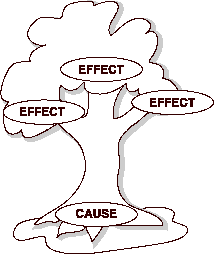
4. Be the Cause, Not the Effect


A masterful motivator of others asks, "What do we want to cause to happen today? What do we want to produce?"
Those are the best management questions of all. People who have a hard time managing people simply have a hard time asking themselves those two questions, because they're always thinking about what's happening to them instead of what they're going to cause to happen.
When your people see you as a cause instead of an effect, it won't be hard to teach them to think the same way. Soon, you will be causing them to play far beyond their own self-concepts.
You can cause that to happen.


Shallow people believe in luck. Wise and strong people believe in cause and effect.
—Ralph Waldo Emerson


Wednesday, March 3, 2010

3. Tune in Before You Turn On

Tune in Before You Turn On

You can't motivate someone who can't hear you.
If what you're saying is bouncing off their psychological armor, it makes little difference how good you are at saying it. You are not being heard. Your people have to hear you to be moved by you.
In order for someone to hear you, she must first be heard. It doesn't work the other way around. It doesn't work when you always go first. Because your employee must first appreciate that you are on her wavelength and understand her thinking completely.
As leadership guru Warren Bennis has said, "The first rule in any kind of coaching is that the coach has to engage in deep listening. Which means that the coach must relate to the context in which the 'other' is reasoning—they must 'tune in' to where the other is coming from. In short, perhaps the basis of leadership is the capacity of the leader to change the mind-set, the framework of the other. That's not easy, as I needn't tell you for most of us, thinking that we have tuned in to the other person, usually are listening most intently to ourselves."
We were working with a financial services CEO named Lance who had difficulties with his four-woman major account team. They didn't care for him and didn't trust him
and dreaded every meeting with him as he would go over their shortcomings.
Lance was at his wit's end and asked for coaching.
"Meet with each of them one at a time," we advised.
"What do I say?"
"Say nothing. Just listen."
"Listen to what?"
"The person across from you."
"What's my agenda?"
"No agenda."
"What do I ask them?"
"How is life? How is life for you in this company? What would you change?"
"Then what?"
"Then just listen."
"I don't know if I could do that."
The source of his major account team's low morale had just been identified. The rest was up to Lance.


Don't tell people how to do things, tell them what to do and let them surprise you with their results.
—George S. Patton

Monday, March 1, 2010

2.Teach Self-Discipline


The myth, which almost everyone believes, is that we "have" self-discipline. It's something in us, like a genetic gift, that we either have or we don't.
The truth is that we don't "have" self-discipline, we use self-discipline.
Here's another way to realize it: Self-discipline is like a language. Any child can learn a language. (All children do learn a language, actually.)And the more you use, the more you can make happen.
If you were an Andhraite transferred to Bangalore to live for a year and needed to make your living there, the more Kannada you used, the better it would be for you.
If you had never used Kannada before, you could still use it.
You can open your little English/Kannada phrases dictionary and start using it. You can ask for directions or help right out of that little dictionary! You didn't need to have been born with anything special.
The same is true with self-discipline, in the same exact way. Yet most people don't believe that. Most people think they either have it or they don't. Most people think it's a character trait or a permanent aspect of their personality.
That's a profound mistake. That's a mistake that can ruin a life.
But the good news is that it is never too late to correct that mistake in yourself and your people. It's never too late to learn the real truth.
And listen to how people get this so wrong:
"He would be my top salesperson if he had any self-discipline at all," a company leader recently said. "But he has none."
Not true. He has as much self-discipline as anyone else does, he just hasn't chosen to use it yet. Just as we all have as many Kannada words to draw upon as anyone else.
It is true that the more often I choose to go to my little dictionary and use the words, the easier it gets to use Kannada. If I go enough times to the book, and practice enough words and phrases, it gets so easy to speak Kannada that it seems like it's part of my nature, like it's something I "have" inside me. Just like golf looks like it comes naturally to Tiger Woods.
Self-discipline is the same.
If the person you lead truly understood that self-discipline is something one uses, not something one has, then that person could use it to accomplish virtually any goal he or she ever set. They could use it whenever they wanted, or leave it behind whenever they wanted.
Instead, they worry. They worry about whether they've got what it takes. Whether it's "in" them. Whether their parents and guardians put it there. (Some think it's put there experientially; some think it's put there genetically. It's neither. It's never put "in" there at all. It's a tool that anyone can use. Like a hammer. Like a dictionary.)
Enlightened leaders get more out of their people because they know that each of their people already has everything it takes to be successful. They don't buy the excuses, the apologies, the sad fatalism that most non-performers skillfully sell to their managers. They just don't buy it.


Discipline Something in human nature causes us to start slacking off at our moment of greatest accomplishment. As you become successful, you will need a great deal of self-discipline not to lose your sense of balance, humility and commitment.------H. Ross Perot Chairman Emeritus of the Board of Perot Systems Corporation 

Discipline is remembering what you want.
—David Campbell, founder, Saks Fifth Avenue
 

Sunday, February 28, 2010

1. Know Where Motivation Comes From


There was a manager named Tom who came early to a seminar we were presenting on leadership. He was attired in an olive green polo shirt and white pleated slacks ready for a day of golf.
The golfer Tom walked to the front of the room and said, "Look, your session is not mandatory, so I'm not planning on attending."
"That's fine, but I wonder why you came early to this session to tell us that. There must be something that you'd like to know."
"Well, yes there is," the manager confessed. "All I want to know is how to get my people on the sales team to improve. How do I manage them?"
"Is that all you want to know?"
"Yes, that's it," declared the manager.
"Well, we can save you a lot of time and make sure that you get to your golf game on time."
The manager Tom leaned forward, waiting for the words of wisdom that he could extract about how to manage his people.
And we told him:
"You can't."
"What?"
"You can't manage anyone. So there, you can go and have a great game."
"What are you saying?" asked the manager. "I thought you give whole seminars on motivating others. What do you mean, I can't?"
"We do give whole seminars on this topic. But one of the first things we teach managers is that they can't really directly control their people. Motivation always comes from within your employee, not from you."
"So what is it you do teach?"
"We teach you how to get people to motivate themselves. That is the key. And you do that by managing agreements, not people. And that is what we are going to discuss this morning."
The manager put his car keys in his pocket and sat down in the first seat closest to the front of the room for the rest of the seminar.
So learn the truth that anything or anyone you motivate must start from you and only You. 


"Leadership is the art of getting someone else to do something you want done because he wants to do it".
—Dwight Eisenhower

Saturday, February 27, 2010

Ways of Motivation

Introduction


Don't believe anything you read in this series.
Even though these 100 easy articles were written from real-life coaching and consulting experience, you won't gain anything by trying to decide whether you believe any of them. Belief is not the way to succeed here. Practice is the way.
Grab a handful of these tried and proven ways to motivate others and use them. 
Try them out.  ..........See what you get................ Examine your results................ That's what will get you what you really want: motivated people.

Most people we run into do what doesn't work, because most people try to motivate others by downloading their own anxiety onto them. Parents do this constantly; so do managers and leaders in the workplace. They get anxious about their people's poor performance and then they download that anxiety on their people. Now everybody's tense and anxious!
Downloading your anxiety onto someone only motivates that person to get away from you as quickly as possible. It doesn't motivate them to do what you really want them to do. It doesn't help them get the best out of themselves.
Managers blame their own people for poor numbers, when it's really the manager's responsibility. CEOs blame their managers, when it's really the CEO. They call consultants in a panic, talk about the numbers, and then ask, "Should we do FISH? Do you recommend FISH?"
"FISH" is a current training fad that has a great deal of value in inspiring employees and focusing on the customer. But we don't deliver fish in this book. We deliver an observation about fish. "A fish rots from the head down," we remind the manager whose people are not performing. And that's our version of fish.
So, the first step in motivating others is for you, if you're the leader wanting the motivation, to realize that "if there's a problem, I'm the problem." Once you truly get that, then you can use these 100 ways.
The mastery of a few key paradoxes is vital. They are the paradoxes that have allowed our coaching and consulting to break through the mediocrity and inspire success where there was no success before.
Paradoxes such as:

1. To get more done, slow down.
2. To get your point across, stop talking.
3. To hit your numbers faster, take them less seriously and make a game of it.
4. To really lead people, go ahead of them.
These are a few of the paradoxes that open leadership up into a spiral of success you have never imagined.
Hope you'll find, as we have, that leadership can be fun if you break it into these easy pieces.